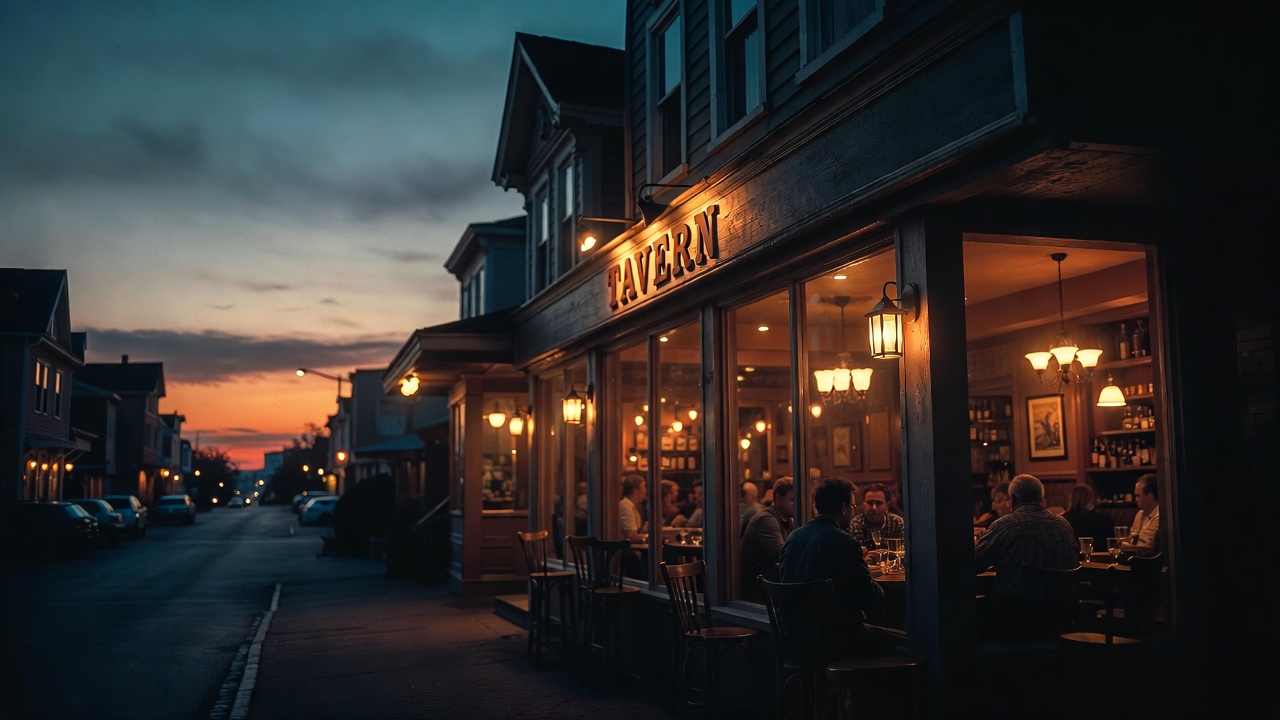
Every city block has one — a corner tavern, a small bar, a place that somehow knows everyone’s name without ever asking.
It might not look fancy. The lights are warm, the stools slightly worn, the air filled with quiet laughter and a rhythm that doesn’t try too hard.
And yet, this is where a neighborhood breathes. Not on the main avenue, not in the mall, but here — where time moves slow enough for people to actually listen.
Local taverns aren’t just about drinks. They’re about presence. They hold the kind of stories that never make headlines but build the texture of community life.
The Rhythm of the Familiar
Every night, regulars return. Some sit at the same spot, others wave at faces they only know by sight.
No one has to perform here. You don’t need to dress up, you don’t need to introduce yourself — you simply show up, and that’s enough.
The beauty of these spaces isn’t what happens inside them, but what doesn’t have to happen.
No curated moments. No algorithm deciding who you talk to. Just people, chairs, and time.
In a world that gamifies attention, the tavern is an offline victory.
It reminds us that not all value is measurable, and not all connections need optimization.
A Place That Holds Stories
If you sit long enough, you start to notice — every table holds a memory.
A group celebrating a small promotion, an old friend back from out of town, someone quietly processing a bad week.
It’s not about what’s poured into the glass; it’s about what’s shared across it.
The tavern works like a neighborhood memory bank.
It collects stories — of joy, of loss, of jokes that make no sense outside that room.
And the regulars? They’re the custodians of those stories.
This is where laughter heals, where silence isn’t awkward, where the idea of “home” expands beyond walls.
The Social Glue We Forget
Sociologists call it the “third place” — not home, not work, but somewhere in between.
The local tavern fits perfectly into that role. It’s where the hierarchy flattens — the shop owner, the teacher, the delivery driver, all sitting within the same few meters of comfort.
That kind of equality is rare. In most parts of urban life, we’re divided by function.
But here, in this dimly lit corner, people meet as humans first.
That’s the invisible currency of taverns: proximity without pretense.
And it’s worth more than whatever’s written on the menu.
The Value That Doesn’t Fade
Cities evolve. Neighborhoods change.
Trendy cafés come and go, but local taverns outlast them because they don’t chase novelty — they protect familiarity.
They survive not by branding but by memory. They keep serving something that no franchise can replicate: belonging.
When someone walks in and the bartender says, “The usual?”, that’s not a transaction — it’s a recognition.
And recognition, in this world, is priceless.
Beyond the Walls
Even when people move away, they carry the tavern with them.
The smell, the sounds, the conversations — all turn into small anchors of identity.
A good tavern doesn’t just serve the present; it preserves the sense of place.
It’s the kind of local infrastructure that keeps a city human.
Because as long as people keep gathering without needing a reason, culture still has a pulse.
The Real Spin of Connection
If you ask anyone why they keep coming back, they’ll probably shrug.
“It’s just nice here,” they’ll say.
But that’s the point — the “just” hides everything.
The small greetings, the shared laughter, the slow comfort of being known — that’s the spin that keeps it all alive.
Not in a way that demands attention, but in the quiet assurance that someone will notice if you don’t show up.
In that sense, local taverns still deliver real value — not in profit, not in prestige, but in the kind of social wealth that keeps neighborhoods from forgetting themselves.
